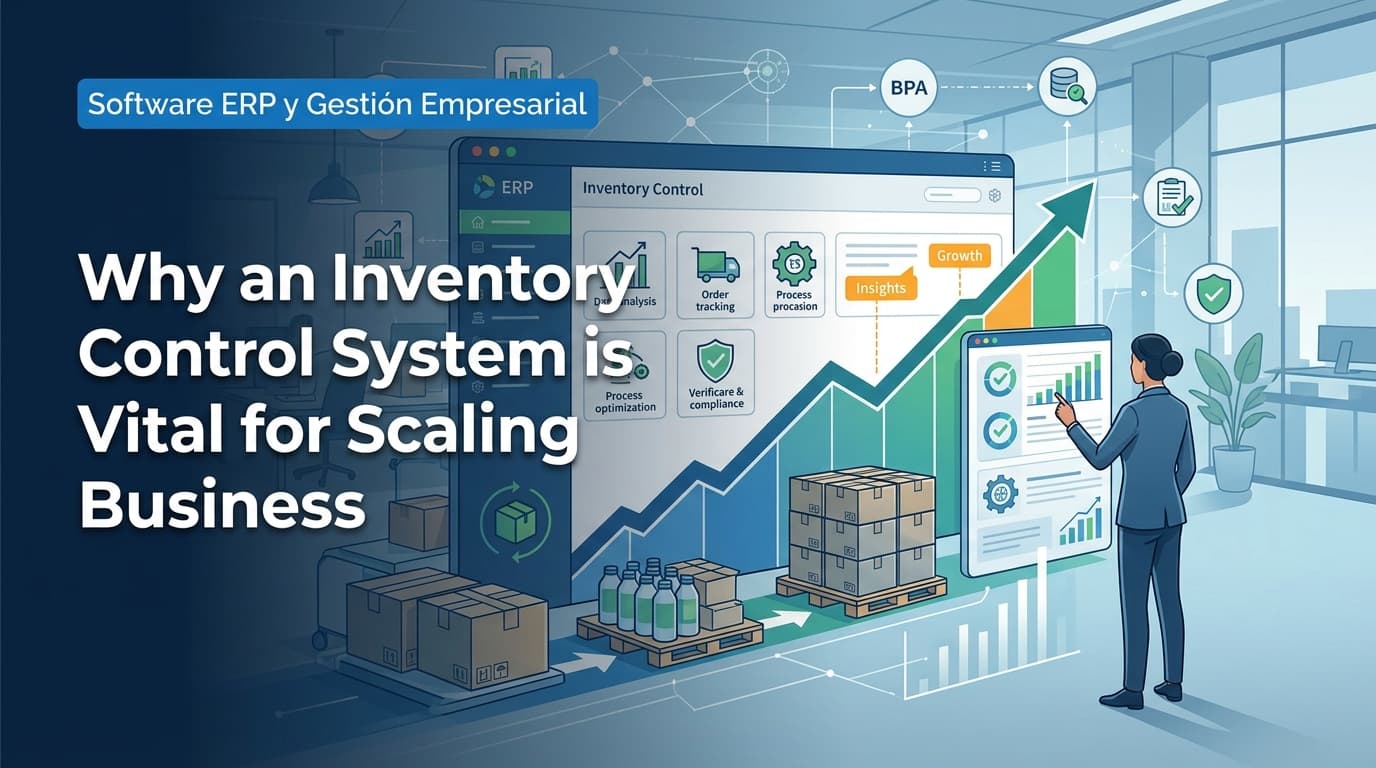
Why an Inventory Control System is Vital for Scaling Your Business
Discover why an inventory control system integrated with an ERP is vital to avoid stockouts, centralize operations, and scale your business effectively.
Why an Inventory Control System is Vital for Scaling Your Business
In the competitive landscape of the Dominican Republic and the wider Caribbean, scaling a business is a delicate balancing act. As your operations grow, the complexity of managing your assets increases exponentially. If you are still relying on manual spreadsheets or disconnected tools, you are likely hitting a ceiling. Implementing a robust inventory control system is not just an upgrade; it is a fundamental requirement for any company aiming to scale without falling into operational chaos.
At AA High Tech, we have seen firsthand how businesses struggle when their inventory data is siloed. Whether you are in retail, distribution, or manufacturing, the inability to track stock in real-time leads to lost sales, bloated carrying costs, and frustrated customers. In this article, we will explore why integrating an advanced inventory control system with your ERP is the secret to sustainable growth.
What is an Inventory Control System?
An inventory control system is a technological solution designed to track, manage, and optimize the flow of goods within a business. It provides real-time visibility into stock levels, movements, and valuations. Unlike basic tracking, a modern system integrates directly with your sales, procurement, and accounting modules, ensuring that every transaction is reflected instantly across your entire organization.
If you are still debating whether to move away from manual methods, read our analysis on why an inventory control system is vital for scaling your business and discover the hidden risks of stagnation.
The Dangers of Manual Inventory Management
Many growing companies start with Excel. While it works for a small startup, it becomes a liability as you scale. Manual data entry is prone to human error, lacks real-time updates, and creates "data islands" that prevent your team from making informed decisions.
We often discuss why the control of inventory in Excel slows down your company's growth and how it creates a bottleneck that prevents you from focusing on strategic expansion. When your team spends more time reconciling numbers than selling products, your growth is effectively capped.
Why Integration with an ERP is Non-Negotiable
An inventory control system is most powerful when it acts as the heart of your ERP software. By centralizing your operations, you eliminate the need for double-entry and ensure that your sales team, warehouse staff, and accounting department are all looking at the same "source of truth."
1. Real-Time Visibility and Accuracy
When your inventory is synced with your POS and e-commerce platforms, you avoid the dreaded "out-of-stock" scenario. You can set automated reorder points, ensuring you never miss a sale due to poor planning.2. Compliance and e-CF Readiness
In the Dominican Republic, the DGII requires strict adherence to electronic invoicing (e-CF). An integrated system ensures that every movement of goods is tied to a valid fiscal document, simplifying your tax reporting. Learn more about new DGII regulations and whether your ERP is ready for electronic fiscal receipts.3. Data-Driven Decision Making
With an integrated system, you can analyze turnover rates, identify slow-moving products, and optimize your procurement strategy. This is the essence of scalability without chaos: how an ERP system centralizes your operations.Leveraging AI for Advanced Inventory Control
We are moving beyond simple tracking. Today, Artificial Intelligence can predict demand patterns, suggest optimal stock levels, and even automate procurement orders. Discover how artificial intelligence is revolutionizing corporate inventory control and why it is a game-changer for your bottom line.
How to Start Your Digital Transformation
Transitioning to a professional system can feel daunting, but it doesn't have to be chaotic. At AA High Tech, we specialize in helping businesses in the Dominican Republic navigate this journey. Whether you are looking to design a digital transformation strategy for your business in the DR or simply need to identify bottlenecks in your company's processes, we provide the expertise to ensure a seamless implementation.
Conclusion
Scaling your business requires moving from reactive management to proactive strategy. An inventory control system integrated with your ERP is the foundation upon which you can build a scalable, efficient, and profitable enterprise. Don't let manual processes hold you back from your true potential.
Ready to eliminate the chaos and start scaling? Contact our team at AA High Tech today to discuss how we can tailor a solution to your specific operational needs.
Frequently Asked Questions
Q: Why is an integrated inventory system better than a standalone one?
A: An integrated system connects your inventory with sales, accounting, and procurement, eliminating manual data entry and ensuring real-time accuracy across all departments.Q: Can an inventory control system help with DGII compliance?
A: Yes. By integrating your inventory with an e-CF compliant ERP, you ensure that every sale and movement of goods is automatically linked to the correct fiscal documentation.Q: Is AI really necessary for inventory management?
A: While not mandatory for small businesses, AI is vital for scaling. It helps predict demand, reduces human error, and optimizes stock levels to prevent overstocking or stockouts.Q: How long does it take to implement an ERP with inventory control?
A: The timeline depends on the complexity of your operations, but with our structured approach, we focus on delivering measurable results quickly to ensure your business continues to run smoothly during the transition.Preguntas Frecuentes
An integrated system connects your inventory with sales, accounting, and procurement, eliminating manual data entry and ensuring real-time accuracy across all departments.
Yes. By integrating your inventory with an e-CF compliant ERP, you ensure that every sale and movement of goods is automatically linked to the correct fiscal documentation.
While not mandatory for small businesses, AI is vital for scaling. It helps predict demand, reduces human error, and optimizes stock levels to prevent overstocking or stockouts.
The timeline depends on the complexity of your operations, but with our structured approach, we focus on delivering measurable results quickly to ensure your business continues to run smoothly during the transition.